A weekly side-work review should make stopping a legitimate decision
A side activity can consume more time and attention than its small income justifies. Review actual effort, costs and personal fit before accepting another round. The purpose is an honest decision about the activity, with continuing, changing the experiment and stopping all available outcomes.
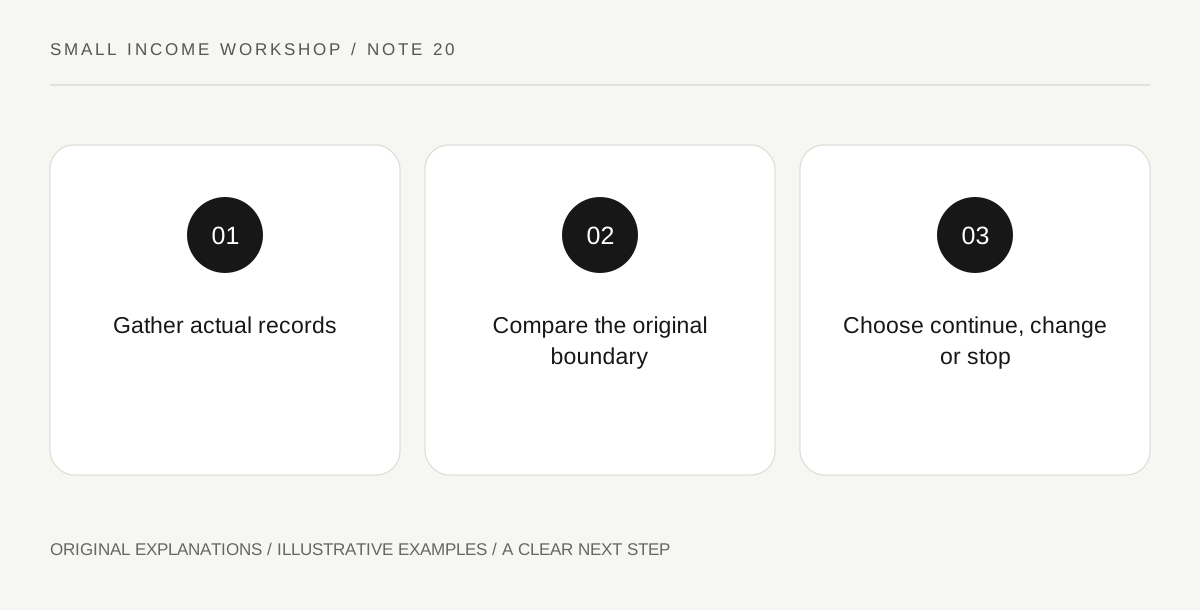
Original explanatory diagram. Read the full method and limitations below.
Gather the week's actual evidence
List completed work, actual receipts, unresolved payments and identified spending. Keep expected income separate from received money. Include time spent finding work, checking, administration and support rather than only the visible production stage. Do not let one unusually good transaction overwrite the wider pattern. SBA planning concepts and FTC cautions about exceptional earnings support this evidence-led review, while your own record supplies the specific observations about the experiment.
Compare the activity with its original boundary
Read the time ceiling, spending limit and question set before the experiment began. Did the work answer the question, or did the activity expand into something different? A growing set of subscriptions or unpaid requests may mean the original boundary no longer describes reality. State the change plainly. Do not treat previous effort as a reason to keep committing resources indefinitely, and avoid inventing a guaranteed payoff just beyond the next purchase or another week.
Include practical personal fit
Consider whether the activity fits study, other work, relationships and ordinary rest without making medical claims or prescribing one schedule for everyone. A technically profitable task can still be a poor fit for your circumstances. You do not need to prove the activity is fraudulent or universally bad in order to decline it. Keep the judgment personal and evidence-based. If the work involves unresolved payment or access issues, close those through appropriate routes rather than simply abandoning sensitive records.
Choose one clear next state
Continue the same bounded experiment, change one defined element or stop and close it. Write the decision and reason in a short note. If continuing, set the next review point and avoid adding several untested changes at once. If stopping, cancel relevant recurring charges through their actual processes, end access appropriately and retain necessary records. The review should reduce confusion, not become another elaborate productivity ritual that consumes the time the side activity was supposed to respect.
Illustrative worked example
Illustrative scenario: a learner's fictional trial produces a small positive remainder but requires more evening administration than expected. The review shows the workload exceeds the original time boundary. They stop the offer, close authorized access and cancel an unused subscription through its stated route. The result is a valid decision, not a failed promise of future income.
Questions that come up
Must I continue because I already bought tools?
Past spending does not establish that more spending or time is justified. Review the current evidence and choose the next step deliberately.
Is stopping evidence that nobody can succeed with this task?
No. It is a decision about your experiment and circumstances. Keep the conclusion personal rather than turning it into an unsupported claim about everyone else.
References and scope
These sources support the factual background. Examples and exercises are original illustrative teaching material. References do not imply endorsement.
- SBA: Plan Your Business — Startup-cost, market-research and simple break-even planning concepts; no demand or earnings guarantee.
- FTC: Earnings Claims and Labor Task Force — Unusually successful examples do not establish likely earnings for everyone; claims need relevant support.
- IRS: Gig Economy Tax Center — US gig income can require reporting even without a payment form; keep records and use current relevant guidance.