Count the time around the paid task before calculating an hourly result
A short paid task can require preparation, messages, checking and administration that never appear in the advertised completion time. Track those stages before calculating an operational hourly result. The number is a description of an observed or clearly fictional scenario, not a promise that others can earn the same rate.
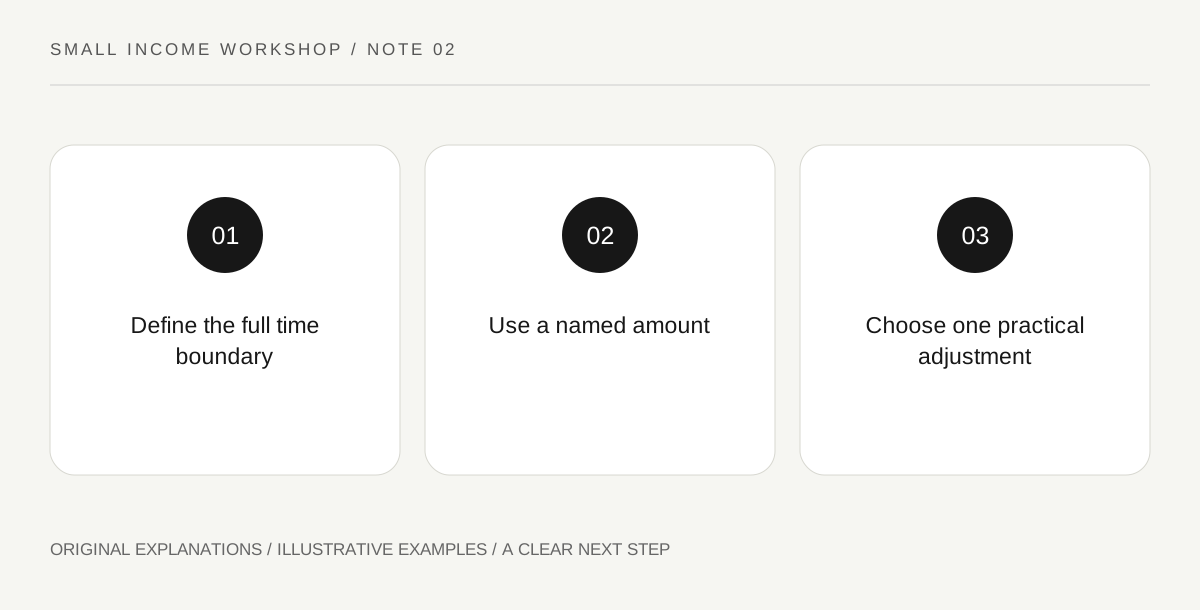
Original explanatory diagram. Read the full method and limitations below.
Define the time boundary
List setup, direct production, review, communication and closeout as separate stages. Include repeated unsuccessful preparation where it genuinely belongs to the experiment. Do not count only the fastest visible action and then call that the complete job. A task that takes ten minutes after an hour of preparation has more than ten minutes of work behind it. Keep personal breaks separate and choose a clear consistent boundary rather than manipulating the denominator to make a result impressive.
Track actual work without constant surveillance
Use a simple timer or start-and-stop note suited to your routine. Record the task and stage rather than collecting intrusive screen recordings or private client content. Estimate honestly when a small interruption makes precise timing unavailable. A rounded transparent estimate is better than false precision. The goal is understanding effort and capacity, not turning every minute of a small side activity into an elaborate monitoring project that consumes more time than it explains.
Use a clearly labeled numerator
Choose whether the calculation uses gross revenue or a documented remainder after known direct costs, and say which. Do not compare a gross hourly figure from one project with an after-cost figure from another. SBA planning concepts help separate costs and revenue, but the arithmetic remains your own scenario. It does not establish employment status, a guaranteed wage or a complete tax result. Keep uncertain costs and unpaid periods visible beside the calculation.
Turn the observation into one change
If administration dominates, improve one manageable process or choose a smaller experiment rather than assuming you must work faster indefinitely. A low result may show that the activity does not fit your available time. Declining another project can be a sensible conclusion. Do not buy an expensive course solely because a disappointing first number feels like a personal failure. The observation should support a decision about the actual work, with no requirement to keep pursuing it.
Illustrative worked example
Illustrative arithmetic: a fictional task brings a 36-unit remainder after identified direct charges. It takes 30 minutes to produce, 30 minutes to prepare and 30 minutes to check and administer. Dividing by the full 1.5 hours gives 24 units per hour within that limited scenario, rather than 72 from production time alone. Neither figure predicts anyone's future earnings.
Questions that come up
Should I count time spent finding work?
Keep it visible as acquisition effort, even if you report it separately from one project. Hiding it can exaggerate what the activity yields for the overall time committed.
Can one good result advertise a typical rate?
One scenario does not establish what other people are likely to earn. FTC guidance cautions against generalizing from unusually successful examples.
References and scope
These sources support the factual background. Examples and exercises are original illustrative teaching material. References do not imply endorsement.
- SBA: Plan Your Business — Startup-cost, market-research and simple break-even planning concepts; no demand or earnings guarantee.
- FTC: Earnings Claims and Labor Task Force — Unusually successful examples do not establish likely earnings for everyone; claims need relevant support.