A sale notification is the start of a money record, not the final result
A platform can celebrate a sale before fees, refunds or other costs are visible. Build a small record that follows the amount through each stage. The purpose is to understand what happened to a real transaction, without turning the largest displayed number into a claim about spendable profit.
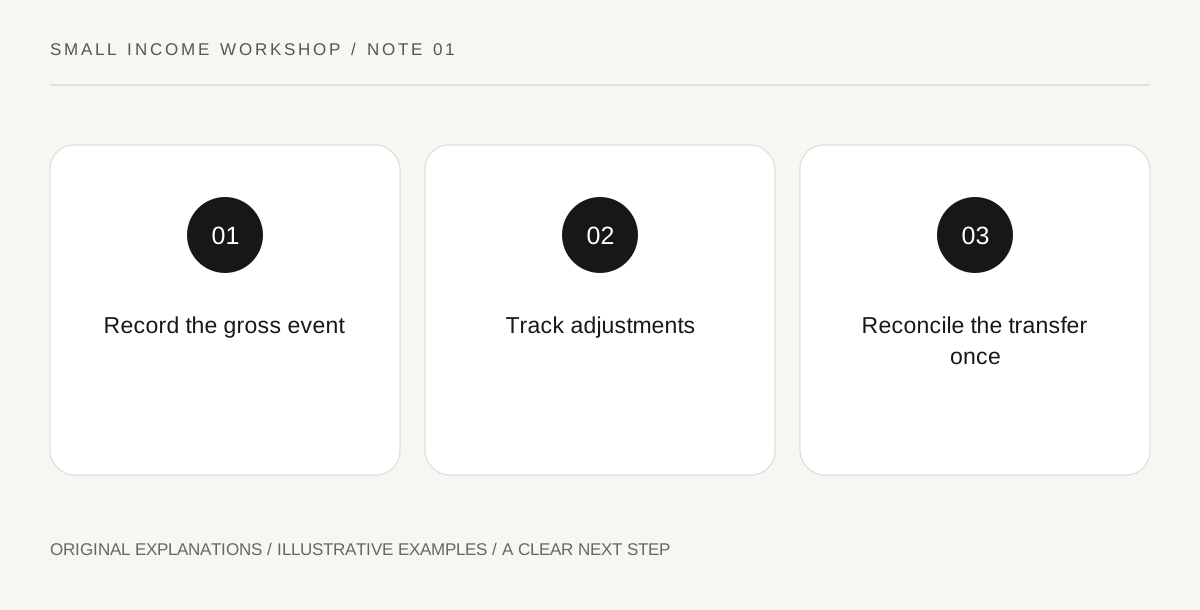
Original explanatory diagram. Read the full method and limitations below.
Record the gross event clearly
Write the order or project identifier, agreed amount, date and currency. Keep the amount before platform deductions in its own field. Do not mix a customer payment with a transfer between your own accounts. The IRS gig-economy resources emphasize keeping appropriate income records; this ledger is an original organizational method rather than a tax form. A clear gross entry provides a starting point that can later be reconciled with the actual statement.
Add deductions as separate events
Record fees, refunds and other identified adjustments using the platform's actual statement. Do not hide them by replacing the gross amount with a smaller unexplained number. Keep supporting documents and note which costs belong to this transaction versus the wider activity. A software subscription shared across several projects needs a separate treatment from a fee charged on one sale. Leave uncertain allocation visible rather than inventing a precise cost for the sake of a tidy result.
Match the transfer without double counting
A payout can combine several transactions or arrive after the sale date. Link the transfer to the underlying entries instead of counting it as new sales income again. Keep the payment processor and bank record as supporting views of the same movement. If the amounts differ, identify the stage where the difference appears before concluding money is missing. Foreign-currency conversion or a reserve may require further documentation, not a guess based on the current account balance.
Keep the result modest
You can calculate an operational remainder from the recorded sale and known costs, while leaving taxes, uncertain costs and personal circumstances to appropriate guidance. Do not label every remainder tax-free profit or assume it is immediately available. Review what the record actually covers and choose a consistent name for the subtotal. A small honest ledger is more useful than an impressive earnings screenshot that cannot explain fees, timing or the work behind it.
Illustrative worked example
Illustrative arithmetic: a fictional sale is 60 currency units. The statement identifies a 6-unit platform charge and a 4-unit refund adjustment, leaving a 50-unit payout before other relevant costs or tax questions. The record preserves all three events and links the transfer once. It does not count 60 plus 50 as two earnings events or claim that 50 is a guaranteed final profit.
Questions that come up
Can I call every deposited amount profit?
Not automatically. A deposit can combine sales and adjustments while other costs or obligations remain. Use precise subtotal labels and relevant professional guidance.
Does a platform dashboard replace my own records?
It can be useful evidence, but you still need an understandable record of the activity and related documents, especially when several services or payment routes are involved.
References and scope
These sources support the factual background. Examples and exercises are original illustrative teaching material. References do not imply endorsement.
- IRS: Gig Economy Tax Center — US gig income can require reporting even without a payment form; keep records and use current relevant guidance.
- IRS: What to Do with Form 1099-K — Payment reporting, personal-item sales and correction questions need actual records and current US guidance.