Set a startup-cost ceiling before a small online-work experiment
A modest side project can accumulate subscriptions, equipment and training before it produces a useful result. Set a bounded experiment and a spending ceiling first. Separate what is essential to test the idea from purchases that merely make the activity feel more established.
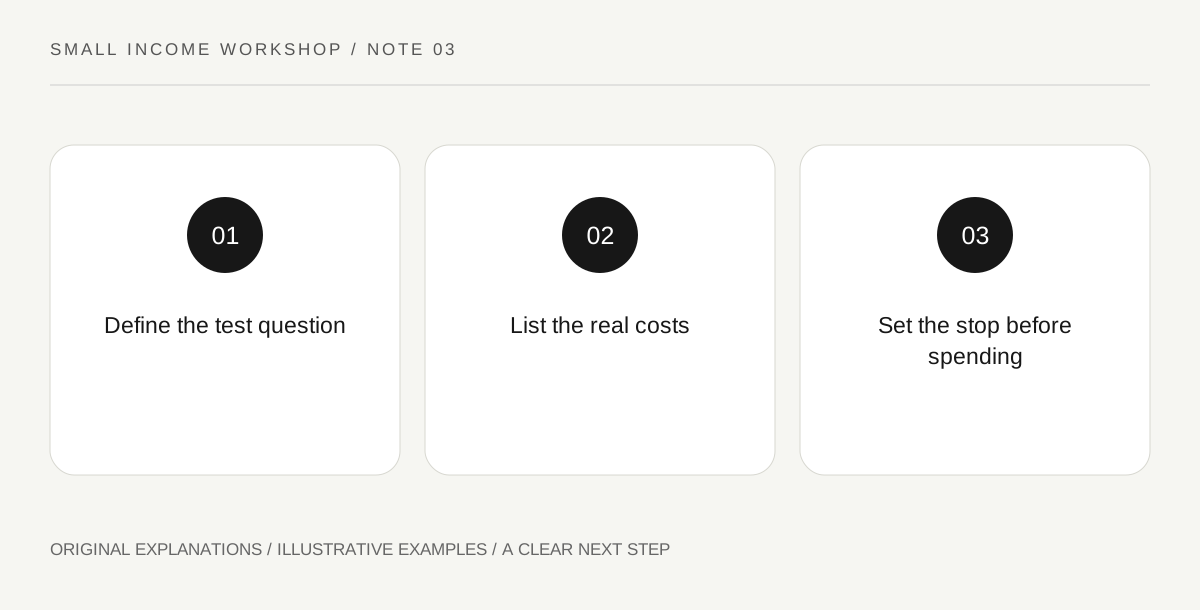
Original explanatory diagram. Read the full method and limitations below.
Name the question the experiment answers
Choose one practical uncertainty: whether you can complete a sample accurately, whether the proposed task fits your available time or whether a small defined audience understands the offer. Do not make immediate income the only possible learning outcome. A clear question limits the work and helps identify which tools are actually necessary. SBA planning resources include startup-cost and market-research concepts; the experiment here applies them at a deliberately small scale without claiming demand has been proven.
List one-time and recurring costs
Record the actual tools, supplies and services needed for the chosen test. Mark charges that renew automatically and costs that arise only after a sale. Avoid assuming a free trial has no future commitment. Use equipment you already have where it legitimately supports the task, while preserving safe and authorized use. Do not label a costly upgrade essential simply because a promoter's demonstration uses it. Ask what the experiment cannot answer without that purchase.
Use simple break-even arithmetic carefully
For a defined product scenario, a basic fixed-cost calculation can divide startup costs by the amount left per unit after known variable costs. Keep the inputs and assumptions visible. If the remaining amount per unit is zero or negative, the simple model does not yield a sensible positive break-even volume. Even a positive result is not evidence that the required sales will occur. Demand, time and ongoing support remain separate uncertainties.
Choose a stopping point before spending
Write the maximum money and time you are prepared to commit to this test, plus the date or output that ends it. Do not keep adding purchases because earlier spending feels wasted. At review, continue only if the evidence and practical fit justify another deliberately chosen stage. A no-purchase sample or a decision to stop can be a successful outcome. The purpose is to make uncertainty manageable, not to disguise speculative spending as a guaranteed route to earnings.
Illustrative worked example
Illustrative arithmetic: a fictional experiment has 40 currency units of fixed setup cost and a possible 8-unit contribution per completed sale after identified variable costs. The simple calculation gives five sales to cover that setup amount. It does not show that five customers exist or that support and tax questions are solved. The creator uses the number as a planning question, not an earnings promise.
Questions that come up
Does a break-even calculation prove the idea will work?
No. It describes a relationship between stated assumptions. Actual demand, delivery capacity and costs require their own evidence.
Should I buy the full professional setup first?
Only buy what a justified task requires. A bounded experiment can often answer an early question with a smaller supported setup, without promising that minimal spending always suffices.
References and scope
These sources support the factual background. Examples and exercises are original illustrative teaching material. References do not imply endorsement.
- SBA: Plan Your Business — Startup-cost, market-research and simple break-even planning concepts; no demand or earnings guarantee.