A rising task balance is not proof that an online job is paying you
A gamified task site can display increasing earnings while asking for your own money to unlock the next stage. Treat the displayed balance and actual payment as separate things. Recognizing that structure early is more useful than trying to win back a growing imaginary amount through another deposit.
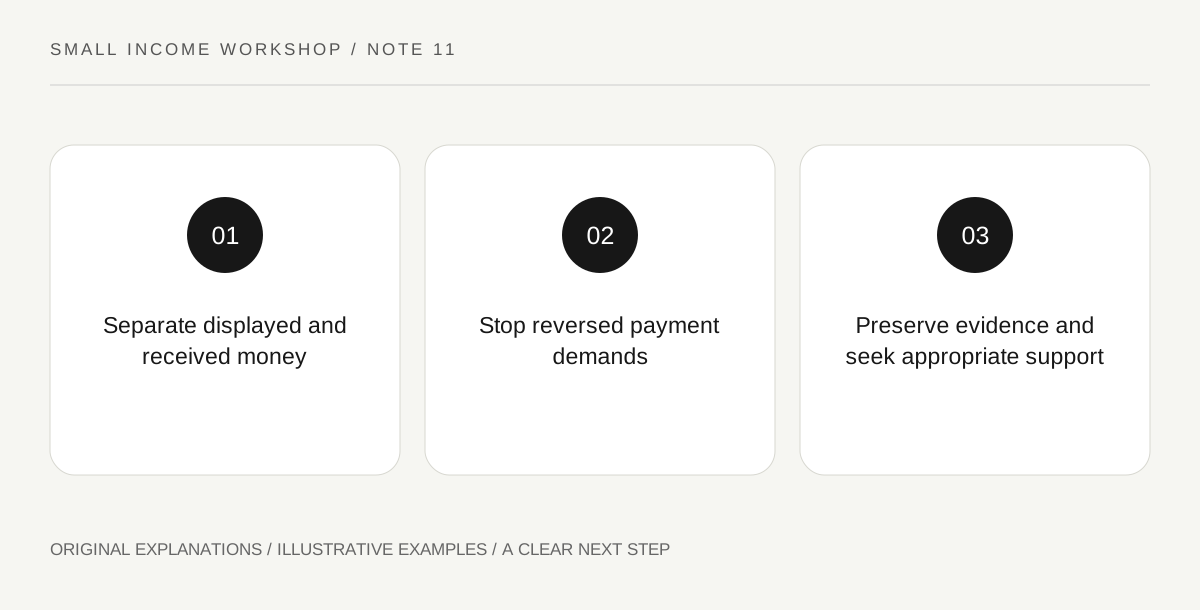
Original explanatory diagram. Read the full method and limitations below.
Read the approach before the dashboard
FTC task-scam guidance describes unexpected work messages involving tasks such as optimization or product boosting. A professional-looking interface and a friendly chat do not independently verify an employer. Record how the approach arrived and whether you can verify the organization through an independent known route. Do not rely solely on contact information supplied by the message itself. A site's moving balance is part of the claim being evaluated, not evidence that the claim is true.
Notice when the payment direction reverses
The critical shift occurs when the worker is asked to deposit money to complete tasks, clear a negative balance or release earnings. FTC guidance warns against paying to get paid. Stop rather than treating the demand as another ordinary work expense. A changing explanation, temporary deadline or promise of reimbursement does not resolve the underlying problem. Do not borrow, buy cryptocurrency or send payment credentials to protect an apparent balance that has not been independently verified.
Keep earlier small payments in perspective
A small actual payment can make later claims feel credible, but it does not validate every subsequent demand. Evaluate the current arrangement on its facts. Do not calculate an expected return from a site's artificial reward ladder or assume a bigger deposit is a reliable way to recover earlier money. A sunk amount can increase emotional pressure without changing the legitimacy of the next request. Seek trusted support if the situation is becoming difficult to assess alone.
Use a factual response route
Preserve relevant messages and transaction details privately, stop sending further money and use appropriate official reporting or payment-provider support when relevant. Do not publish credentials or follow a stranger promising guaranteed recovery for another fee. A report can document the event, but this article cannot promise funds will return. The useful outcome is interrupting the payment demand and keeping a clear record, rather than trying to complete the site's game under increasing pressure.
Illustrative worked example
Illustrative scenario: an unsolicited task site shows a fictional 300-unit balance and demands 80 units to unlock withdrawal. The learner recognizes that a displayed number is not a confirmed payment and stops. If an earlier small payment occurred, it is recorded separately instead of used to justify the new deposit. No recovery outcome or actual platform is invented.
Questions that come up
Can a realistic dashboard prove a job is genuine?
No. The interface displays claims controlled by the operator. Verify the organization and payment arrangement independently.
Should I pay one last fee to recover the balance?
FTC guidance warns against paying to get paid. Stop the payment cycle and use appropriate trusted and official support rather than another promised unlock.
References and scope
These sources support the factual background. Examples and exercises are original illustrative teaching material. References do not imply endorsement.
- FTC: Task Scams — Fake task balances and demands to pay to unlock earnings are scam patterns; no recovery guarantee.
- FTC: Job Scams — Job-scam patterns include payment demands and reshipping arrangements; verify through independent channels.