An earnings screenshot needs the missing denominator and cost context
A large number can be real yet still fail to explain what an ordinary participant is likely to earn. Ask about the people, time and costs behind an online-income claim. The goal is to assess the evidence without accusing someone of fabrication solely because a promotional screenshot is incomplete.
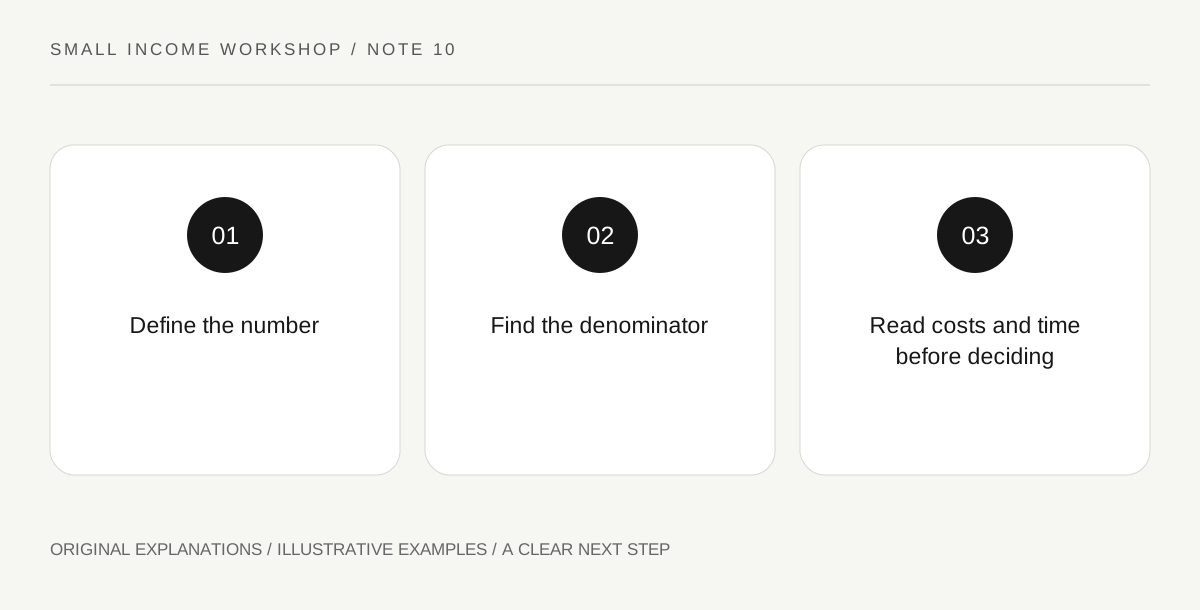
Original explanatory diagram. Read the full method and limitations below.
Identify what the displayed number measures
Read whether the amount is revenue, payout, profit, a cumulative balance or another subtotal. Note currency and period. A cropped image may remove the label that gives the number meaning. Do not assume a sales dashboard has already subtracted every cost or that a pending balance is received money. Ask for the underlying definition before comparing the claim with a wage or deciding whether to buy a course or opportunity.
Ask who is included in the story
A single successful person, a selected group and all participants are different populations. FTC guidance explains that unusually successful earnings do not by themselves support a claim that others are likely to achieve the same result. Look for the denominator and selection method. Were unsuccessful attempts and people who stopped included? Do not invent a typical figure from a few testimonials or treat a missing denominator as proof of a particular numerical failure rate.
Keep costs and time visible
Ask what spending, unpaid effort and relevant conditions sit behind the result. A gross amount accumulated over many years is different from a recent monthly operational remainder. Training, tools, inventory and advertising may affect the picture, depending on the actual activity. Avoid calculating a promised hourly result from a screenshot whose work-time boundary is unknown. The right response to missing information is uncertainty, not a flattering estimate that makes the opportunity seem accessible to everyone.
Choose a decision that does not depend on the headline
If an opportunity requires payment, evaluate the actual deliverable and terms without relying on an unverified future-income promise. You can decline when the evidence is insufficient. A promoter's confidence or urgency does not fill the gap. Keep any factual concern tied to the exact claim and use appropriate reporting resources where relevant. The article is an evidence-reading method, not a guarantee that every documented opportunity will work or that every impressive result is false.
Illustrative worked example
Illustrative scenario: a course advertisement shows one creator's large cumulative sales total. A learner asks about the period, costs and number of participants represented. The available material does not establish typical results, so the learner does not use the screenshot as an income forecast. Any decision about the course must instead consider its actual teaching deliverable and price.
Questions that come up
Can a genuine screenshot still mislead?
It can be incomplete or unrepresentative even if the number is authentic. Context and the claim made from it matter.
Does missing typical-results evidence prove nobody earns money?
No. It means the available material does not establish the broader result claimed. Keep that uncertainty accurate rather than replacing one unsupported conclusion with another.
References and scope
These sources support the factual background. Examples and exercises are original illustrative teaching material. References do not imply endorsement.
- FTC: Earnings Claims and Labor Task Force — Unusually successful examples do not establish likely earnings for everyone; claims need relevant support.