A resource-link check should report verified access and unresolved meaning separately
A small link-checking project can help maintain a public resource list, but opening a page does not prove its advice is accurate or suitable. Define the service as a bounded access and identity review. Report what was checked, when and which questions require the source owner's judgment.
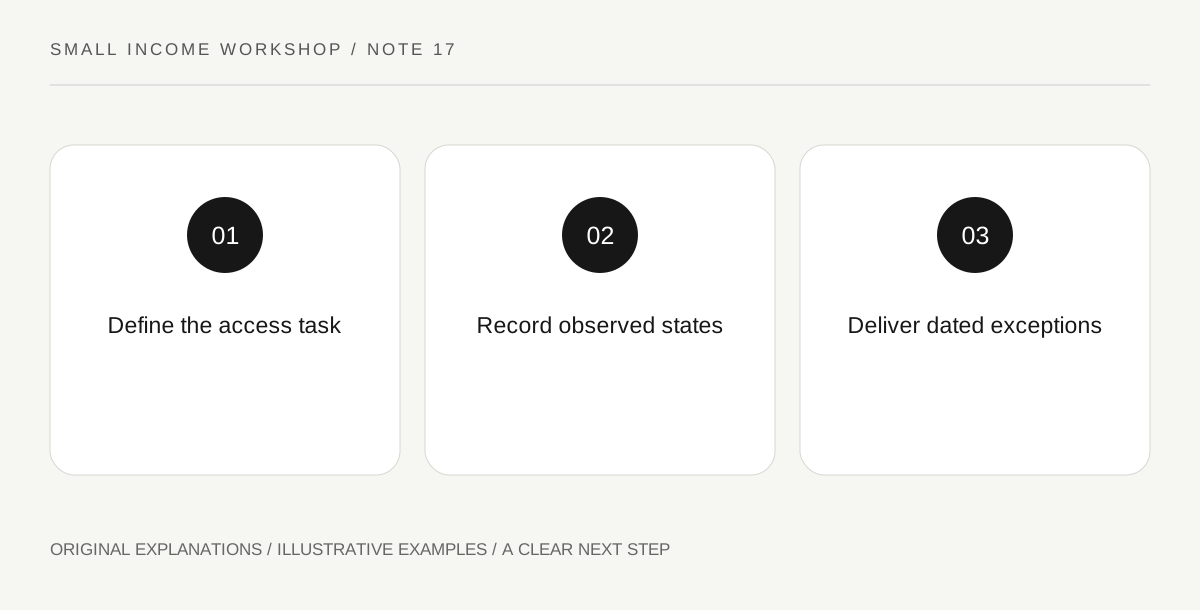
Original explanatory diagram. Read the full method and limitations below.
Agree on the review scope
Specify the supplied list, the fields to check and the permitted actions. A basic task might record whether a public link opens, whether the title matches and whether a documented redirect changes the destination. It should not silently become legal, medical or financial fact-checking. SBA planning concepts support a limited service experiment; this example does not prove demand or provide a current rate. Use only authorized public resources and respect access restrictions.
Define informative status labels
Use clear states such as opened, redirected, inaccessible or requires owner review, with short notes. A temporary error and a permanently removed page may look similar during one check, so do not claim certainty beyond the observation. Keep the check date and destination address. An accessible login screen does not mean the intended article is available to the audience. The status should describe the actual result rather than a green tick that hides what was or was not inspected.
Separate access from content quality
If a page opens and the title matches, that establishes a narrow access observation. It does not certify every claim, license or recommendation on the page. Flag an obvious subject mismatch or changed destination without rewriting the resource owner's conclusions. If high-stakes content needs review, route it to appropriate expertise. Do not invent a replacement source merely because a broken link makes the list look incomplete. A useful unresolved note can be safer and more honest.
Deliver a traceable maintenance record
Keep the original list, checked result, date and concise exception notes. Explain the time boundary and any pages not checked because of access limits. Avoid collecting private account content or asking for broad credentials to complete an ordinary public-link task. The final sample should let the owner decide what to repair, replace or retain. A polished report demonstrates a bounded process rather than claiming that the whole resource collection is now factually verified forever.
Illustrative worked example
Illustrative scenario: a fictional public list has twelve links. Ten open as expected, one redirects to a general homepage and one returns an error during the check. The report keeps those states distinct and flags the redirected item for owner review. It does not substitute an unrelated page or call the ten accessible pages medically or legally verified.
Questions that come up
Does a working link prove its advice is correct?
No. Accessibility and factual suitability are different questions. A bounded link-check service should say which one it reviewed.
Should I replace every broken source automatically?
Only if replacement research is authorized and within competence. Otherwise flag the issue with enough context for the owner to decide.
References and scope
These sources support the factual background. Examples and exercises are original illustrative teaching material. References do not imply endorsement.
- SBA: Plan Your Business — Startup-cost, market-research and simple break-even planning concepts; no demand or earnings guarantee.
- FTC: Cybersecurity for Small Business — Small operations still need appropriate account, device and customer-data protection.