Test a catalog-cleanup service with an exception log rather than a perfect-looking spreadsheet
Cleaning a small product catalog can be a bounded service experiment when the source rules are clear. Use a sample that exposes uncertainty instead of silently guessing missing facts. The useful output includes corrected entries, traceable changes and an exception list for questions the source cannot answer.
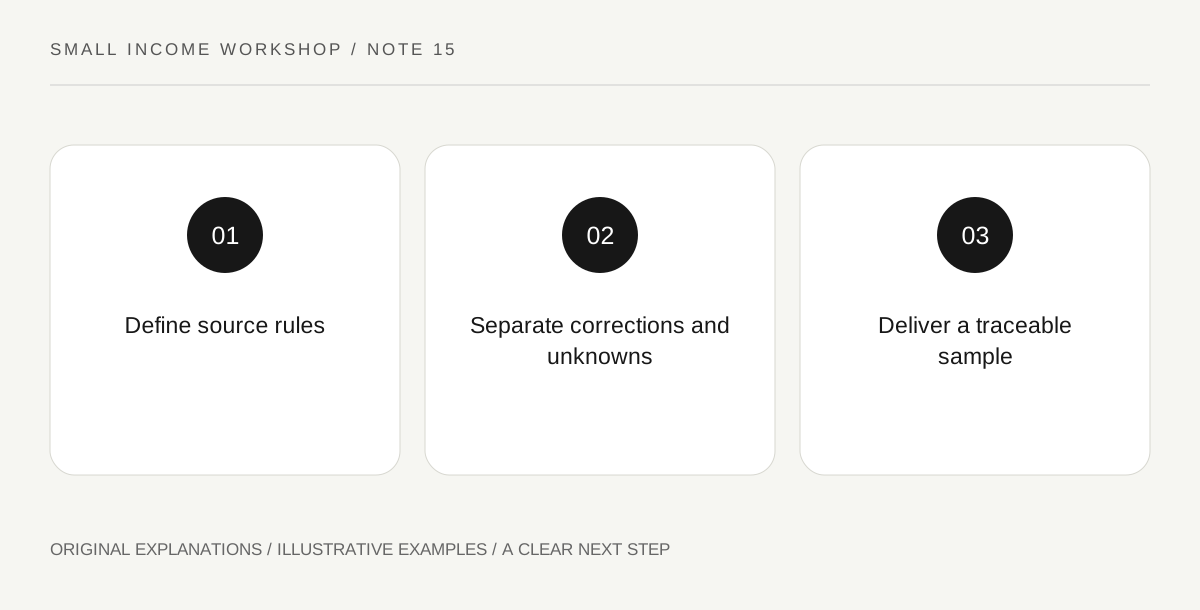
Original explanatory diagram. Read the full method and limitations below.
Choose a defined input and rule set
Start with an authorized sample and a limited group of fields, such as product names, provided identifiers and category spelling. Ask which source is authoritative and which changes are permitted. Do not invent missing dimensions, ingredients or compatibility details from similar products. A cleanup task is different from original product research. SBA market-research and planning concepts support defining a small test, but they do not establish demand or a likely price for this particular service.
Separate mechanical corrections from factual decisions
Consistent capitalization or an obvious duplicate space can be treated differently from a conflicting model number. Write the rule for each allowed correction. If two source records disagree, flag the conflict rather than choosing whichever looks plausible. The exception log is part of the deliverable, not evidence of failure. A table with visible unknowns can be more trustworthy than one filled with confident invented values that later reach a customer-facing page.
Measure the actual work boundary
Track intake, cleanup, checking and exception explanation. A small sample can reveal whether the task fits your skill and available time. Do not advertise a large throughput from the fastest few rows or assume every catalog has the same complexity. Keep source data private and use only authorized tools and accounts. If personal or sensitive information is present unnecessarily, resolve access and handling before beginning rather than uploading the file to an arbitrary public service.
Review a traceable sample output
Keep the original sample, a changed copy and a concise explanation of rules and unresolved entries. Use a small set of meaningful checks, such as whether identifiers were preserved and whether flagged conflicts remain visible. Do not claim product-data certification or invent a client result from the exercise. The experiment can produce evidence of your process while still concluding that you need more practice or that the task is unsuitable for a paid offer at this stage.
Illustrative worked example
Illustrative scenario: a learner receives an authorized fictional twenty-row catalog. They standardize category spelling according to a supplied list but flag two conflicting identifiers and one absent measurement. The sample handoff includes an exception log instead of guessed values. Time is recorded for review as well as editing. No customer, fee or business outcome is claimed from the demonstration.
Questions that come up
Should every blank be filled to make the output look complete?
No. Missing source facts should remain identified rather than invented. A useful exception list communicates exactly what the client or source owner needs to resolve.
Can a sample prove there is market demand?
It can demonstrate a process under stated conditions. Demand and price require separate evidence, with no guaranteed earnings inferred from a polished sample.
References and scope
These sources support the factual background. Examples and exercises are original illustrative teaching material. References do not imply endorsement.
- SBA: Plan Your Business — Startup-cost, market-research and simple break-even planning concepts; no demand or earnings guarantee.
- FTC: Cybersecurity for Small Business — Small operations still need appropriate account, device and customer-data protection.