An event-registration cleanup sample should preserve people's choices
A registration list can contain duplicate-looking names, inconsistent fields and private information. A small cleanup service needs clear owner rules before changing it. The aim is a traceable usable list that preserves attendees' choices, rather than a superficially tidy table produced by guessing who should be merged or removed.
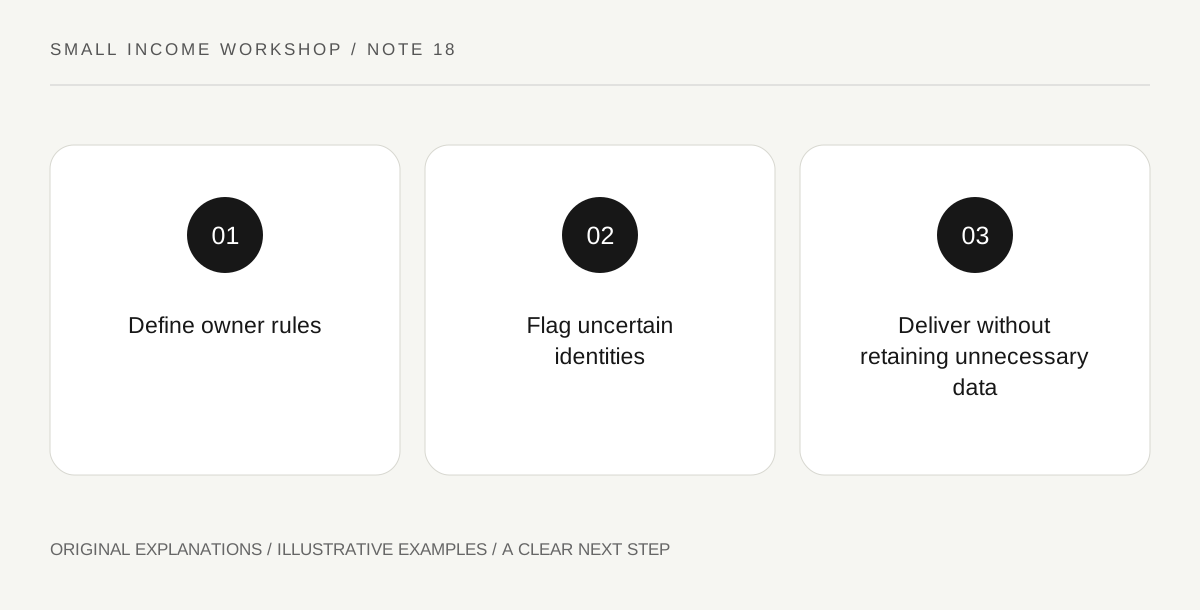
Original explanatory diagram. Read the full method and limitations below.
Define the authorized fields
Ask the organizer which fields matter and which transformations are permitted. A name, contact field, attendance choice and accessibility request can have different handling needs. Do not collect extra personal information to make the table seem complete. FTC small-business cybersecurity guidance reinforces the need to protect customer data even in a small operation. Use an authorized sample or fictional data for practice, keeping actual participant information out of a public portfolio.
Treat possible duplicates as questions
Two people can share a name, while one person can register with a spelling variation. Do not merge records solely from a superficial match. Use the organizer's approved identification rule and flag uncertain cases. Preserve the original entries and explain any confirmed change. A duplicate-removal count is not a quality measure if legitimate registrations disappear. The useful output includes an exception list that makes uncertainty visible before it affects attendance or communication.
Preserve meaningful choices
Standardizing category spelling is different from changing what someone selected. Keep dietary, access and consent-related fields within the organizer's documented process, and do not infer a preference from another answer. If a field is unclear, flag it for appropriate follow-up rather than silently filling it. The cleanup worker should not contact participants or send messages unless that action is separately authorized. A tidy export must still represent the information people actually provided.
Close the work with access boundaries
Deliver through an appropriate authorized route and agree how working copies will be retained or removed. Avoid keeping a private attendee archive as a future marketing resource. A sample can show rules and traceability using fictional data while protecting real people. Track the time spent clarifying and checking, not only editing cells. The experiment may reveal that the task needs more expertise or a better organizer process before it is suitable as a paid service.
Illustrative worked example
Illustrative scenario: a fictional registration list contains two identical names with different identifiers. A learner flags the pair instead of merging it. They standardize one approved attendance-category spelling and preserve the original choices. The sample handoff includes the rule and exception, with no real attendee data. The result demonstrates controlled handling rather than an invented client success.
Questions that come up
Can I use the cleaned list to advertise my services?
Not without an appropriate basis and authorization. The data was supplied for a specific task, and a public portfolio should use suitable fictional or properly permitted material.
Does fewer rows always mean better cleanup?
No. Deleting legitimate records is a failure even if the table looks simpler. Use meaningful checks and preserve unresolved identity questions.
References and scope
These sources support the factual background. Examples and exercises are original illustrative teaching material. References do not imply endorsement.
- FTC: Cybersecurity for Small Business — Small operations still need appropriate account, device and customer-data protection.
- SBA: Plan Your Business — Startup-cost, market-research and simple break-even planning concepts; no demand or earnings guarantee.