Selling an old personal item creates cash movement before it creates a business-profit story
Clearing unused belongings can bring money into an account without demonstrating a repeatable online business. Keep the item's original context, sale proceeds and selling costs visible. US tax treatment also distinguishes circumstances that require actual records, so avoid treating every marketplace deposit as the same kind of income.
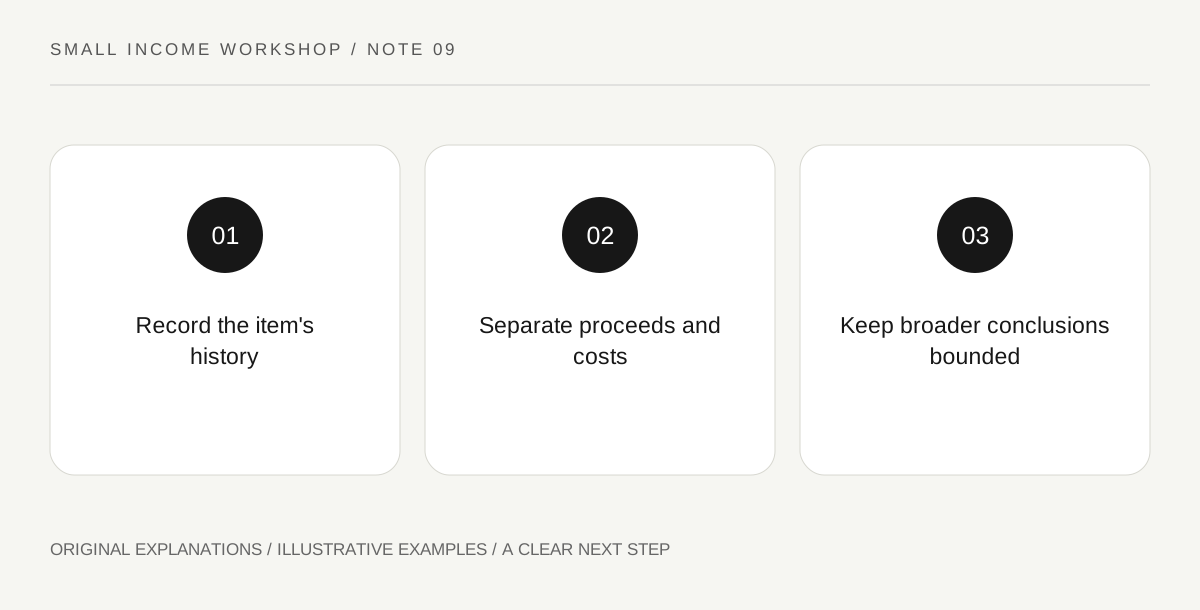
Original explanatory diagram. Read the full method and limitations below.
Identify the item's original role
Record whether the object was a personal possession or acquired as stock for resale, using the facts rather than choosing a convenient label afterward. Keep available purchase information, description and condition with the sale record. A one-time household clear-out is not automatically evidence of ongoing customer demand for a business idea. The operational question is what actually happened to this item, not how impressive the sale looks in a dashboard screenshot.
Separate sale price from recovered value
Record the gross sale, platform charges, shipping and any other identified direct costs. Keep the original purchase information separately rather than assuming that all money received is newly created profit. A personal object can be sold for less than it originally cost while still producing a positive deposit. That is a useful arithmetic distinction. It does not by itself decide the tax result, which needs current relevant guidance and individual facts.
Use the current tax source for the actual circumstance
The IRS Form 1099-K guidance specifically addresses personal-item sales and distinguishes relevant scenarios. Read the current official instructions for the tax year and seek appropriate advice when needed. Do not copy an old social post's threshold or filing line into a new return. If records are incomplete, describe the gap honestly rather than inventing a purchase price. Keep tax documents private and use a suitable verified route for help.
Avoid turning a clear-out into a guaranteed hustle
A few successful sales can teach useful listing, packing and recordkeeping skills. They do not prove that buying replacement stock will produce the same outcome. Inventory introduces new spending, storage and demand questions. Review those separately before committing money. You can enjoy a tidier room and a recovered amount without describing the activity as passive income or promising others an easy repeated return. The conclusion should fit the actual limited transaction.
Illustrative worked example
Illustrative arithmetic: a fictional personal item originally cost 100 currency units and sells for 45, with 5 in identified direct selling costs. The account receives 40 after those charges. Calling that deposit a 40-unit business profit hides the original context. The example does not determine tax liability; it demonstrates why sale proceeds, costs and the item's history need separate records.
Questions that come up
Does a positive payout mean the sale made a profit overall?
Not necessarily. It is one cash movement, while original cost and other relevant facts may change the interpretation.
Can I scale personal-item sales by buying lots of stock?
That is a new business experiment with new costs and demand uncertainty. A household clear-out does not establish its likely outcome.
References and scope
These sources support the factual background. Examples and exercises are original illustrative teaching material. References do not imply endorsement.
- IRS: What to Do with Form 1099-K — Payment reporting, personal-item sales and correction questions need actual records and current US guidance.
- SBA: Plan Your Business — Startup-cost, market-research and simple break-even planning concepts; no demand or earnings guarantee.