A payout calendar should distinguish earned, pending and available amounts
Work completion, platform approval and money arriving in an account can happen on different dates. Keep those states separate before planning around the payment. A clear calendar helps manage the activity's timing without treating a projected payout as cash already available or advising someone to borrow against an uncertain transfer.
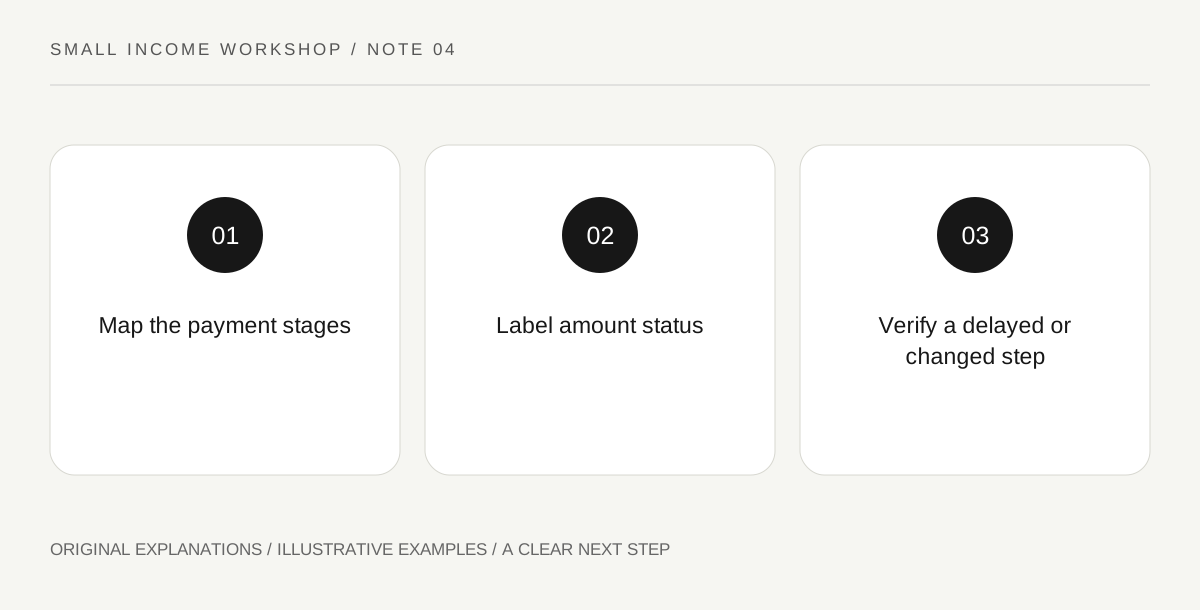
Original explanatory diagram. Read the full method and limitations below.
Map the stated payment stages
Read the actual service or client terms and identify what triggers each stage. A completed task may need review, while an issued payout may still be in transit. Do not assume all platforms use the same vocabulary or delay. Record the source and check date for any operational rule. If a term remains unclear, ask through a verified route before accepting more work on the assumption that money will arrive immediately.
Give amounts a status as well as a date
Use plain labels such as invoiced, approved, pending transfer and received where they match the actual arrangement. Keep expected dates visibly different from confirmed dates. A dashboard balance can be useful information without being an available bank balance. Do not combine the same amount across several stages into a larger total. The IRS recordkeeping context supports preserving income documents, while this status calendar remains an original management aid rather than a tax-accounting determination.
Plan activity costs without assuming instant access
Identify required outlays that occur before payment, such as an approved direct material cost or a recurring tool charge. Keep them separate from personal living costs and avoid using an uncertain future payout as a reason to accept an unaffordable commitment. This guide does not recommend credit or an emergency-fund amount. A smaller project or a different payment arrangement may fit the circumstances better, and declining work can be appropriate when the timing is not manageable.
Review an overdue state factually
If an expected stage does not occur, check the actual record and terms, then use the appropriate support route. Keep messages and reference information organized without exposing payment credentials. Do not pay an unexpected fee to unlock supposedly earned money; FTC task-scam guidance identifies that kind of demand as a serious warning pattern. The calendar should reveal the discrepancy, not normalize a changing sequence of payment demands or promise recovery if money has already been sent.
Illustrative worked example
Illustrative scenario: a fictional platform approves work on Monday and states a later transfer process. A learner records approval separately from receipt and schedules no new spending against the pending amount. When a message demands a deposit to release earnings, they stop and verify through the genuine service route. The example does not claim a particular platform's current payout schedule.
Questions that come up
Does a pending dashboard balance mean I can spend it?
It is not the same as confirmed available funds. Read the actual service and account information rather than assuming a screen total settles access.
Can a calendar guarantee an on-time payment?
No. It helps identify stages and discrepancies, while actual payment depends on the arrangement and relevant processes. Keep uncertain dates visibly provisional.
References and scope
These sources support the factual background. Examples and exercises are original illustrative teaching material. References do not imply endorsement.
- IRS: Gig Economy Tax Center — US gig income can require reporting even without a payment form; keep records and use current relevant guidance.
- FTC: Task Scams — Fake task balances and demands to pay to unlock earnings are scam patterns; no recovery guarantee.