An invoice register should show what is requested and what is actually paid
Issuing an invoice creates a payment request, while receipt of money is another event. Keep both visible in a small register, with any correction or partial payment linked clearly. This management record helps explain the work's cash movement without deciding the tax treatment or legal status of every arrangement.
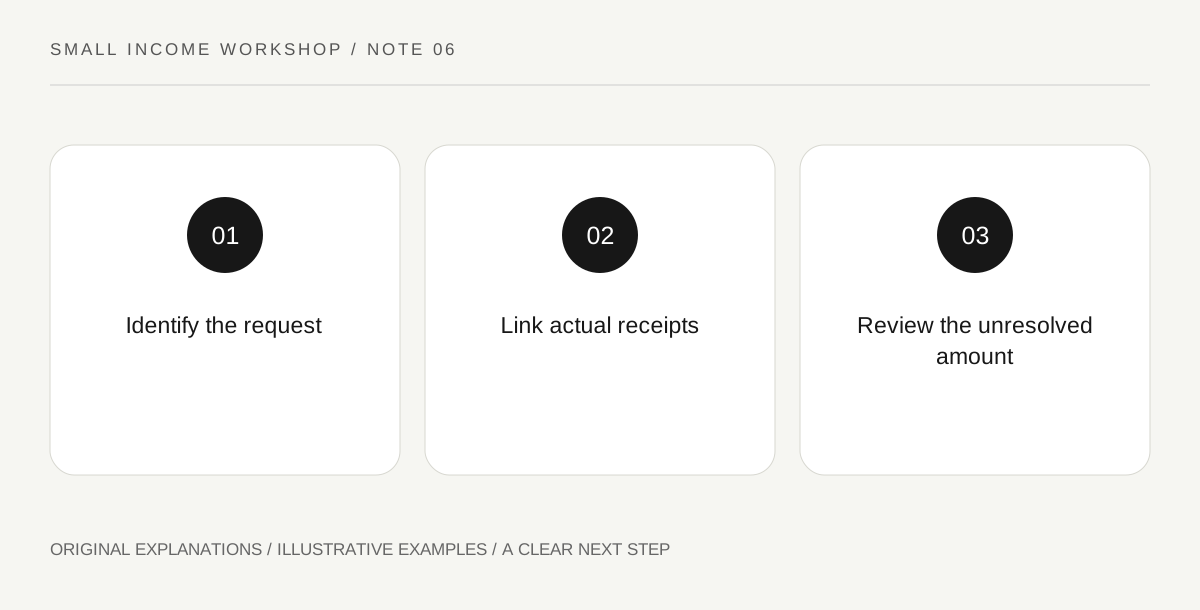
Original explanatory diagram. Read the full method and limitations below.
Give the request a stable identity
Record a unique invoice reference, the relevant project, issue date, agreed amount and stated payment terms. Preserve the document actually sent rather than silently overwriting it after a correction. Keep customer personal details only where necessary and store them appropriately. The IRS gig-economy resources support adequate income records, but a practical register is not a substitute for the required tax or accounting method applicable to an individual activity.
Track responses without changing the original event
If a customer queries the request, note the date and issue separately. A correction should identify what changed and link to the original request using an appropriate process. Do not rewrite the history to make a delay disappear. Keep disagreements about scope or completion factual, and use the relevant agreement and qualified advice when needed. A register can explain the sequence; it cannot independently prove who is right in a contractual dispute.
Match partial payments deliberately
Record each received amount and its reference, then show the remaining unresolved amount. A payment covering several requests should be allocated according to reliable information rather than guessed from similar totals. Keep processing charges in their own field when relevant. Do not mark the full request paid solely because a notification arrived. Confirm the actual receipt through the proper account route, without clicking an unexpected message that asks for credentials or a release payment.
Review outstanding items at a manageable interval
Use the actual agreed terms to identify what needs attention and contact the appropriate party through a verified route when authorized. This article drafts a recordkeeping method; it does not send messages or prescribe collection tactics. Keep any support or resolution reference with the entry. An unpaid request remains unpaid in the record until the outcome is known. Honest status is more useful than adding every issued invoice to a public income claim as though it were received money.
Illustrative worked example
Illustrative arithmetic: a fictional invoice requests 90 currency units. Two confirmed payments of 30 and 40 are linked to it, leaving 20 unresolved before any separately documented adjustments. The register keeps the original request and both receipts. It does not count the invoice and the payments as three independent sales or assume the remaining amount will arrive on a particular day.
Questions that come up
Does an invoice prove money has arrived?
No. It records a request. Actual receipt and any outstanding balance need their own reliable evidence.
Can this register determine my tax reporting method?
No. Use current guidance and appropriate professional help for your circumstances. The register supplies clear underlying records, not an individualized tax conclusion.
References and scope
These sources support the factual background. Examples and exercises are original illustrative teaching material. References do not imply endorsement.
- IRS: Gig Economy Tax Center — US gig income can require reporting even without a payment form; keep records and use current relevant guidance.
- FTC: Cybersecurity for Small Business — Small operations still need appropriate account, device and customer-data protection.