An expense receipt records a purchase before it proves a tax deduction
A receipt can help explain what a small work experiment cost, while its tax treatment is a separate question. Keep purpose, amount and relationship to the activity visible. The record should support accurate review without assuming that every purchase made during a side project automatically qualifies for a deduction.
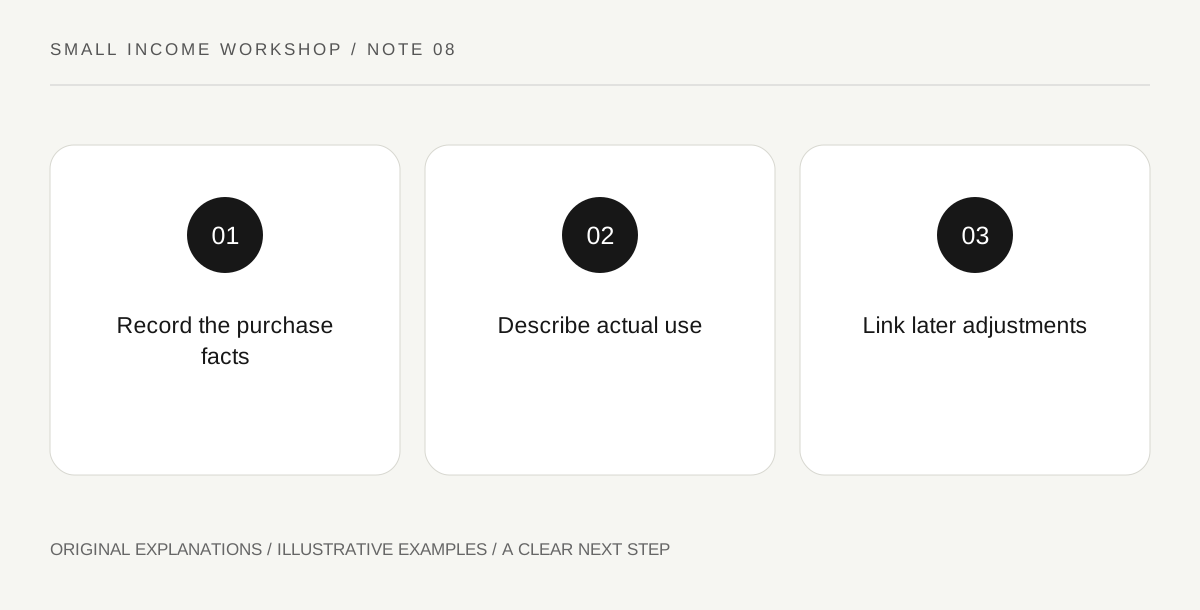
Original explanatory diagram. Read the full method and limitations below.
Record the factual purchase
Save the date, seller, item, amount and payment reference. Add a short note explaining why it was bought and which activity used it. A vague receipt for miscellaneous supplies becomes harder to understand months later. IRS gig-economy guidance emphasizes adequate records of income and expenses. That supports keeping evidence; it does not turn this article into a determination of deductible categories or replace current rules for a person's location and circumstances.
Separate direct and shared use
A purchase used only for one project differs operationally from a tool also used personally or across several activities. Record the actual use information you can support and mark uncertain allocation openly. Do not invent a business-use percentage to make the spreadsheet look complete. A private management estimate can be useful if clearly labeled, but it should not silently become a tax claim. Seek appropriate professional advice where classification or allocation matters.
Link refunds and reimbursements
If the seller refunds a purchase or another party reimburses it, attach that event to the original record. Avoid continuing to treat the original outlay as an unreduced cost in every calculation. Keep the agreement and actual receipt separate where reimbursement is only promised. The same money can otherwise be counted several times in a casual notebook. A clear link preserves the history without erasing the fact that the purchase originally occurred.
Review spending for the experiment itself
Even when tax treatment remains unresolved, the record can answer whether the activity consumes more money than expected. Compare required purchases with optional upgrades and recurring subscriptions. Do not buy something merely to create a supposed deduction or assume a future tax effect makes an unaffordable item free. A bounded work experiment should stand on a realistic cost picture, with legal and tax questions handled through their appropriate sources rather than optimistic labels in a personal ledger.
Illustrative worked example
Illustrative scenario: a learner buys a subscription used for both personal projects and a small paid task. The receipt records the actual purchase, while a note describes the mixed use and leaves allocation unresolved. When part of the charge is refunded, the adjustment is linked. The learner can review operational spending without presenting an unsupported deduction amount.
Questions that come up
Does saving a receipt make an expense deductible?
No. It provides evidence of a purchase. Tax treatment depends on relevant rules and circumstances and may require qualified advice.
Can a deduction make a purchase free?
Do not assume that. Keep the real outlay and any possible tax treatment separate, and avoid spending on the basis of an unverified future effect.
References and scope
These sources support the factual background. Examples and exercises are original illustrative teaching material. References do not imply endorsement.
- IRS: Gig Economy Tax Center — US gig income can require reporting even without a payment form; keep records and use current relevant guidance.
- SBA: Plan Your Business — Startup-cost, market-research and simple break-even planning concepts; no demand or earnings guarantee.