Buy a learning course for its teaching deliverable, not an earnings promise
A side-income course can combine useful instruction with promotional claims about what buyers will earn. Evaluate those separately. A clear curriculum, suitable level and realistic practice task are more concrete than a screenshot of someone else's revenue, and no purchase is required when the teaching offer remains unclear.
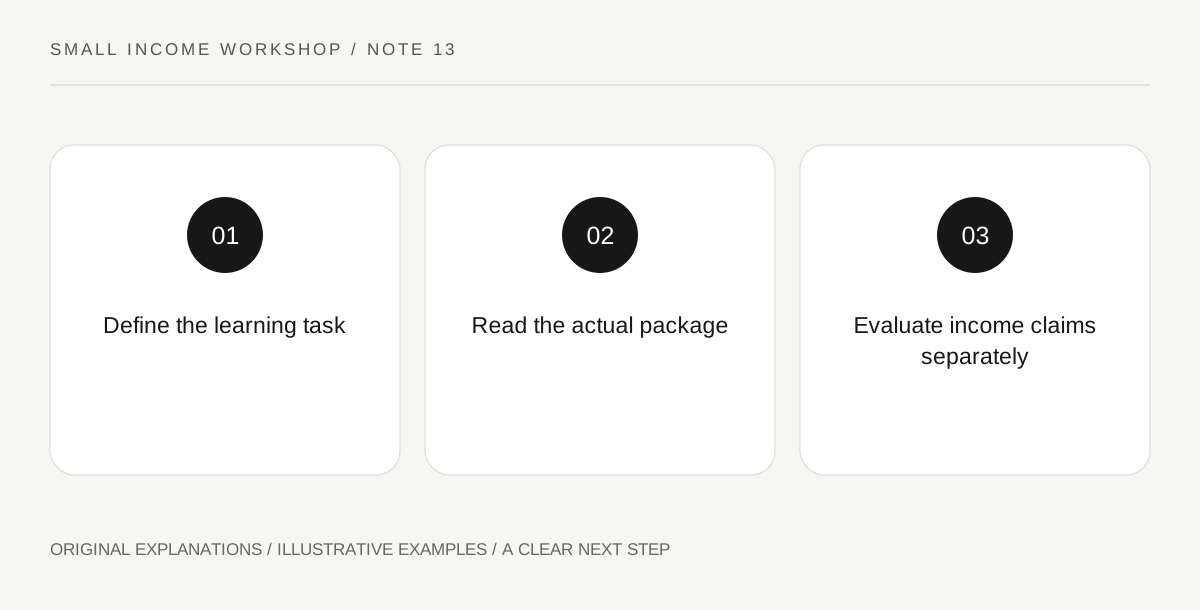
Original explanatory diagram. Read the full method and limitations below.
Name the skill you need to learn
Write one observable task you currently cannot complete and the level you need. A course about online business in general may be too broad to answer it. Look for prerequisites, examples and the actual practice work offered. Do not assume a more expensive program is more suitable. SBA planning concepts support defining the task and costs before committing resources; the question here is what learning deliverable the purchase actually supplies.
Inspect the teaching package
Read the syllabus, format, access period, feedback arrangement and relevant software requirements. A video library, live coaching and graded exercises are different services. Ask about material gaps through a verified route before payment. Do not infer personal support from a testimonial mentioning a mentor if the current package does not include it. Keep the seller's actual conditions and any refund terms with the decision, without assuming a universal right to change your mind later.
Separate outcomes under the learner's control
A course can supply instruction and practice while customer demand and future revenue depend on many other factors. FTC guidance cautions against generalizing from exceptional earnings examples. Ask whether the advertised result concerns demonstrated learning or promised income. An attractive income story does not establish that the same result is typical, and a guarantee should be read through its actual conditions rather than treated as a reason to ignore the underlying uncertainty.
Choose a bounded learning route
Compare the course with suitable primary documentation, library resources or smaller learning options where available. This is not a recommendation for any named provider. Consider time as well as price: unused access does not create skill. Set a practical completion goal and spending ceiling before buying. You can decline a course because its level or package does not fit, without deciding the teacher is fraudulent. The decision should rest on a specific learning need and a clear deliverable.
Illustrative worked example
Illustrative scenario: a learner wants to clean a small product catalog accurately. A broad income course advertises large monthly results but provides no relevant practice exercise or feedback details. The learner instead defines the missing skill and compares appropriate educational options on their actual teaching scope. No course is purchased merely to pursue the advertised earnings figure.
Questions that come up
Does an impressive student result prove I will earn the same?
No. A selected success does not establish your likely outcome or the typical result. Read the evidence and the actual teaching package separately.
Should I always choose free material?
Cost is one factor. Appropriate structure or feedback may have value, but the purchase still needs to fit a defined learning task and realistic available time.
References and scope
These sources support the factual background. Examples and exercises are original illustrative teaching material. References do not imply endorsement.
- SBA: Plan Your Business — Startup-cost, market-research and simple break-even planning concepts; no demand or earnings guarantee.
- FTC: Earnings Claims and Labor Task Force — Unusually successful examples do not establish likely earnings for everyone; claims need relevant support.